Case study
Fridge Etiquette: A Compliance Course Built to Overdo Everything
Business problem
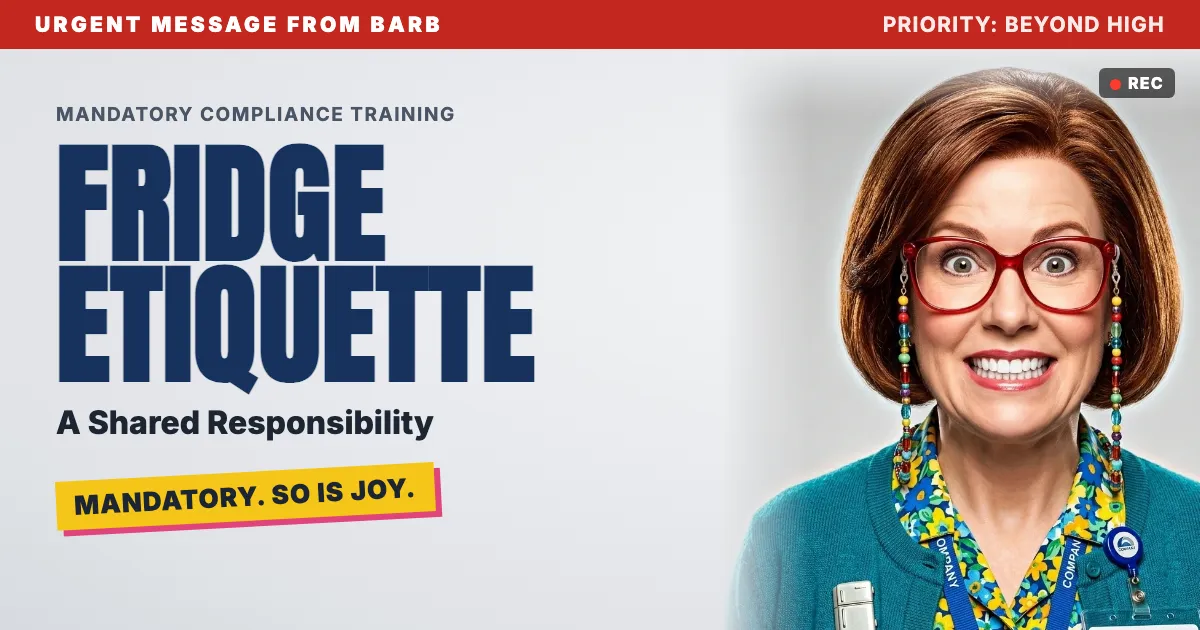
A design challenge brief: Office Manager Barb keeps posting signs about the breakroom fridge, and employees keep leaving spoiled, unlabeled food anyway. The assignment was a refrigerator compliance course built with deliberately excessive AI-generated content, the kind of course that looks polished at first glance and slowly reveals it is doing the absolute most for no reason.
 Enlarge
Audience
Two audiences at once. Inside the fiction, every employee at a mid-size company who uses the shared fridge. Outside it, instructional designers in The eLearning Designer's Academy community, who would recognize every compliance-course habit being exaggerated.
Constraints
The brief required eight elements: a talking-head video with an unsettling AI avatar, a 3D action figure, a caricature, an overcomplicated infographic, overdone AI video, inaccurate stock photos, vibe-coded games, and at least one interaction that exists because it can. The course still had to teach to the brief's real learning objectives. It had to run as a single file with no LMS or back end so anyone could open it from a link. AI video was paid by the credit, so every clip had to be scripted to work on the first or second generation.
My role
Designer, writer, and producer. I set the instructional structure, wrote Barb's scripts, generated and art-directed every image, voice track, and video, and directed the build. Claude (Anthropic's AI) wrote the HTML and JavaScript under my direction.
Approach
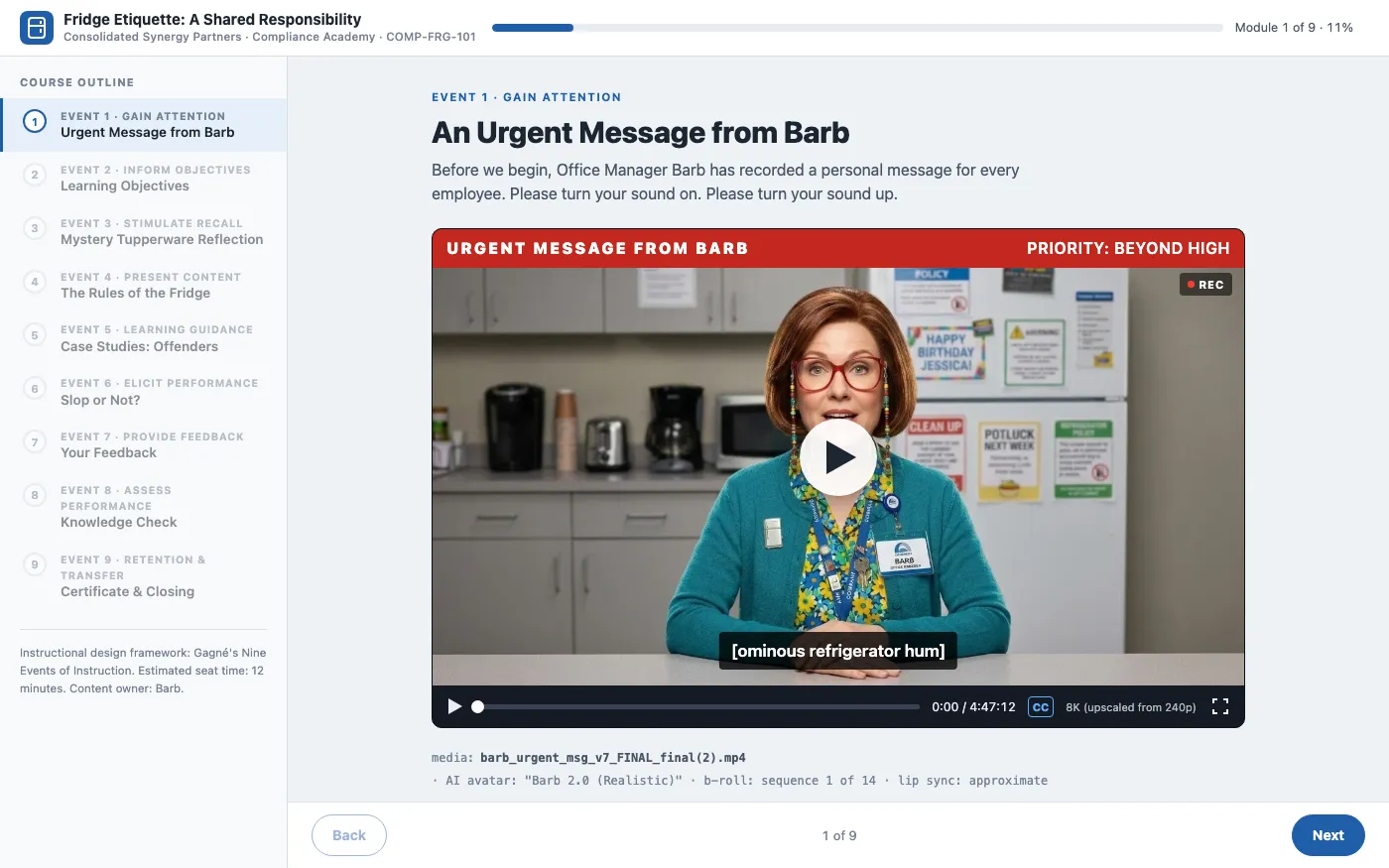
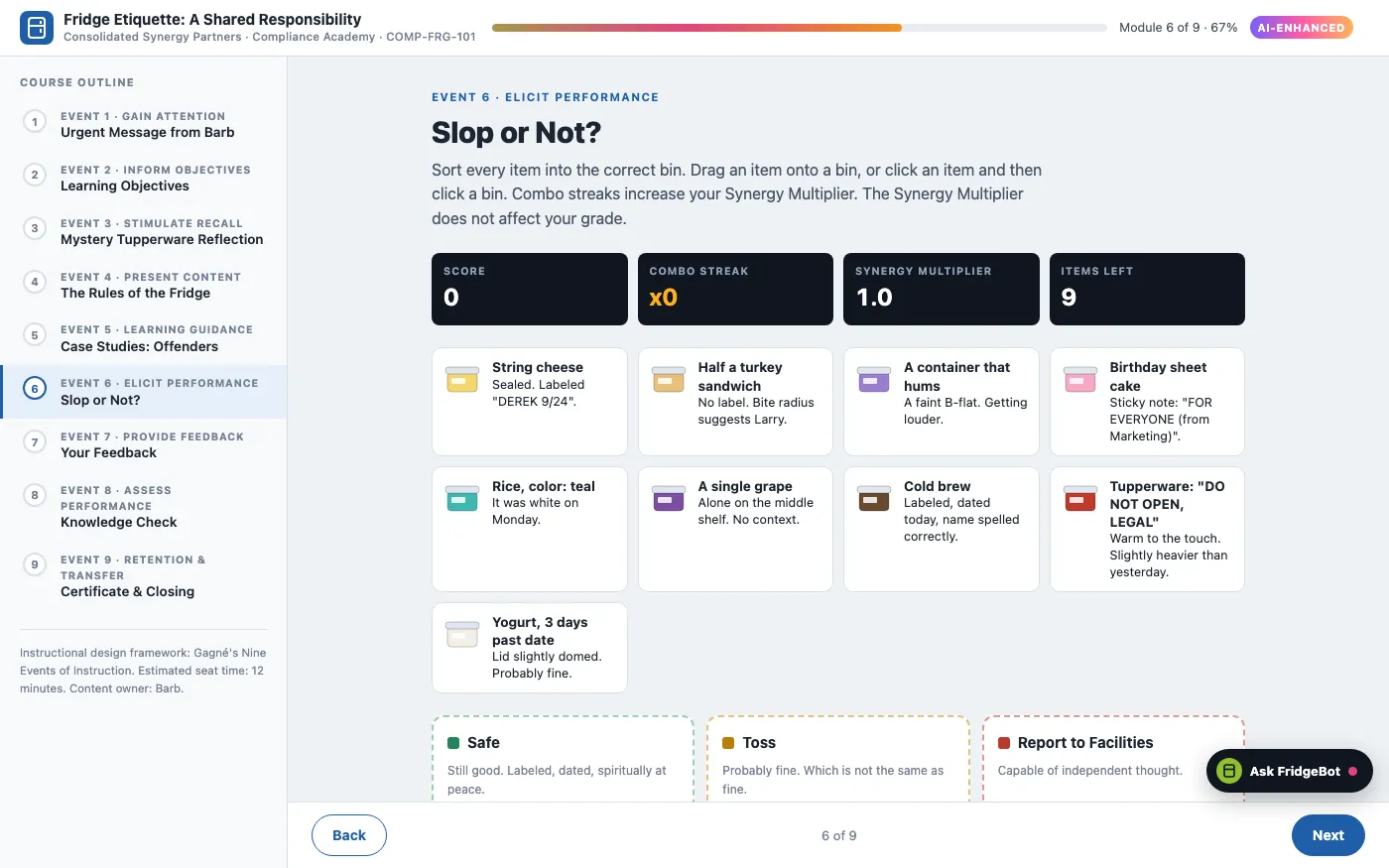
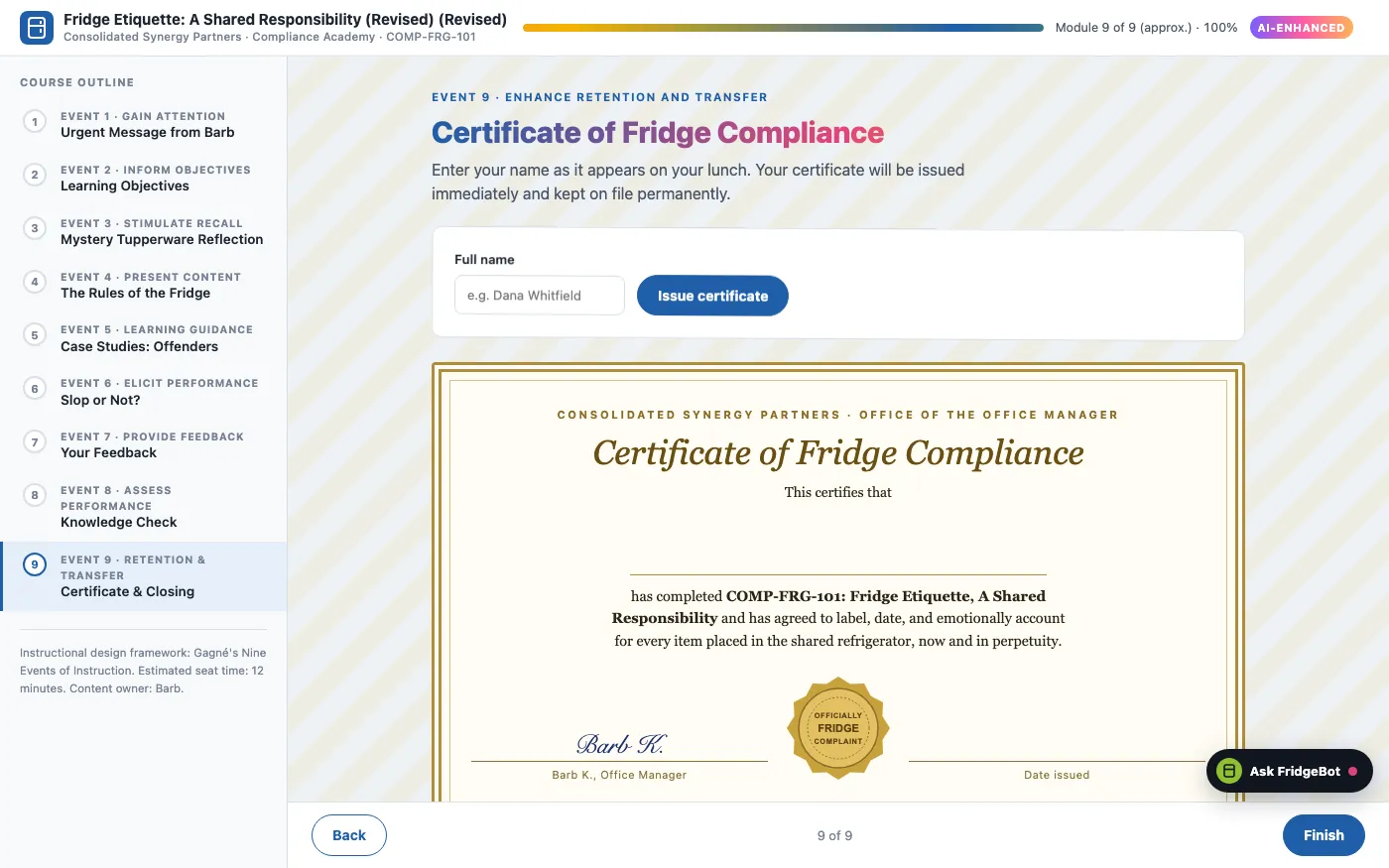
I built the instructional design straight and put all of the absurdity in the assets. The course runs nine screens mapped to Gagné's Nine Events of Instruction, from an urgent video message from Barb (gain attention) to a Certificate of Fridge Compliance (retention and transfer). Each activity maps to an objective from the brief. The Slop or Not? sorting game uses the brief's own three categories as its bins: still good, probably fine, and capable of independent thought. Three offender case studies (Larry from Payroll, Denise from Marketing, Todd from IT) each cover one objective: unlabeled leftovers, lack of space, and smells. Each has three decision points with Barb's guidance. A five-question knowledge check with drag matching and a branching question gates the certificate at 80 percent.
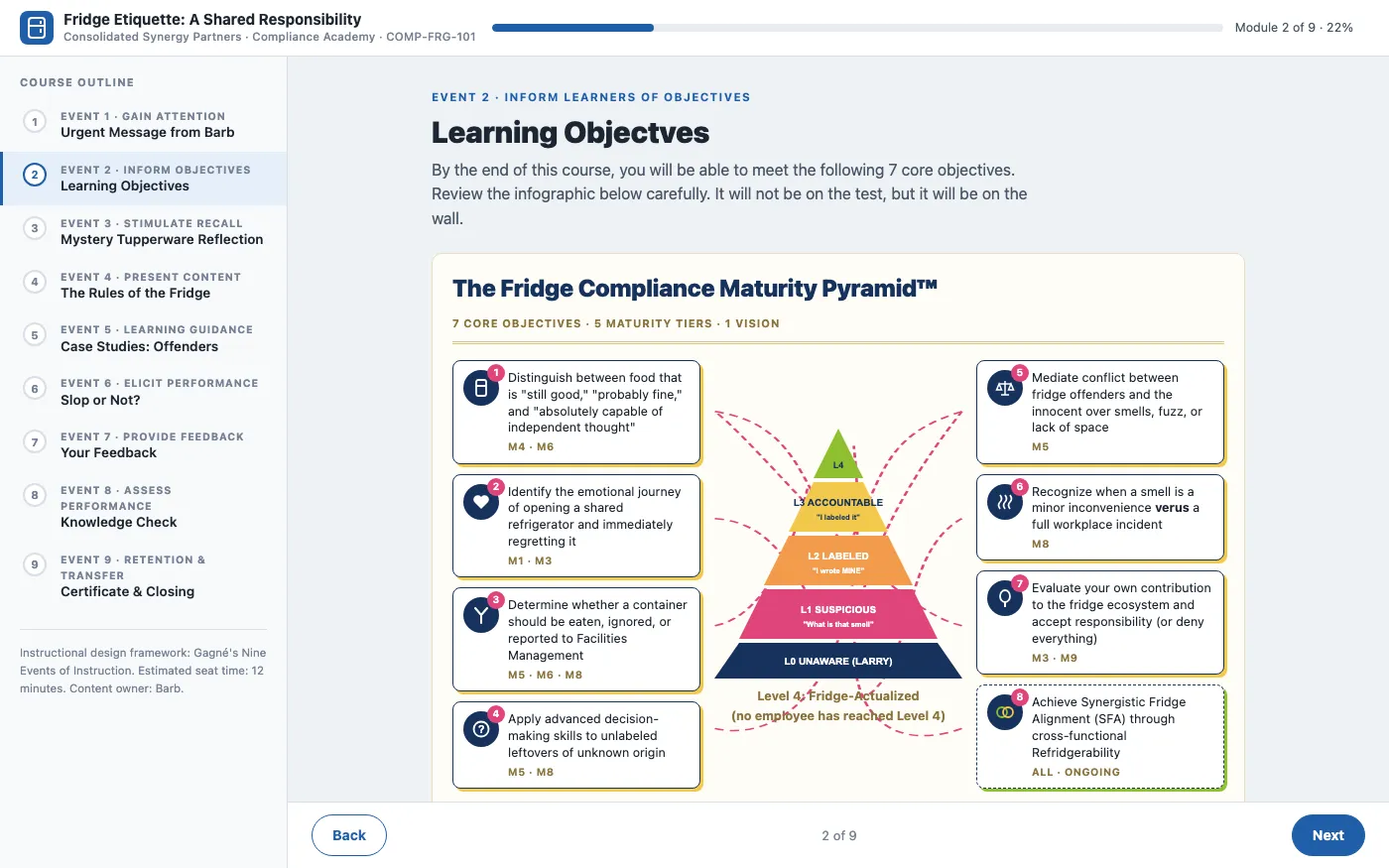
Every required element sits inside that structure. The infographic is a Fridge Compliance Maturity Pyramid with percentages that add up to 225. The stock photos have six fingers and an arm with a hand at each end, and the captions describe them as if nothing is wrong. Barb's action figure ships with a Leftovers Defender shield and a Passive-Aggressive Post-It Launcher. FridgeBot, a chatbot that lives in the fridge, is the interaction that exists because it can.
For production, I generated Barb's reference sheet and stills in Gemini and ChatGPT, built her voice in ElevenLabs, and lip-synced four talking-head videos on Higgsfield (Wan 2.7) with captions timed to the audio. B-roll was animated on Seedance 2.0. The sorting game works by drag or by click, so it does not depend on a mouse. A hidden reviewer unlock opens the last two screens so judges can get to the assessment and certificate without replaying the course.
 Enlarge
Evidence of impact
This was a contest entry, so there is no learner data. The finished course is live and public, and it runs in a browser with no login: mikevictorick.github.io/fridge-etiquette.
Deliverables
A nine-screen interactive course in a single HTML file, hosted on GitHub Pages. Four AI avatar videos with captions, animated B-roll, a sorting game, three branching case studies, a knowledge check, a certificate (printing disabled by Facilities), and a set of share thumbnails.
What I learned
Satire only lands if the structure underneath is correct. Every time a joke started driving a screen, the screen got worse, and the fix was always to go back to the objective and let the asset carry the joke. AI video also needs the same planning as a real shoot. Scripts written to length, one clear action per clip, and captions timed after the audio saved more credits than any prompt trick.