Case study
Zom-B-Gone Shelters: Scenario-Based Onboarding for New Shelter Owners
Business problem
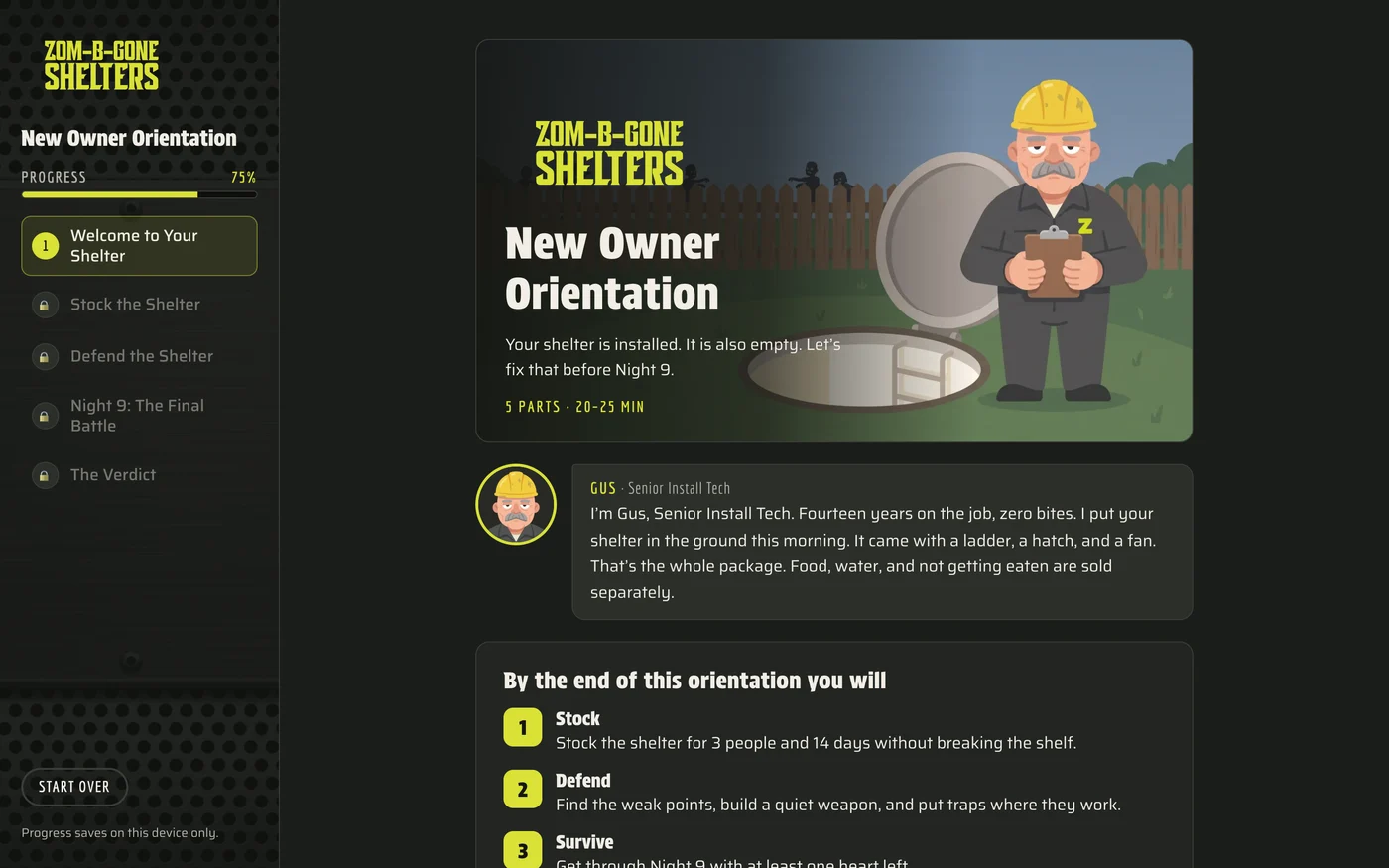
The eLearning Heroes challenge was to prepare someone for the zombie apocalypse. I gave the learner a job. They just bought a Zom-B-Gone backyard shelter, and it was delivered empty. That's the same problem every customer onboarding team has: someone owns the product and has no idea how to use it. In this case, getting it wrong means getting eaten.
 Enlarge
Audience
New shelter owners with no prep experience. Adults who skim anything that looks like a manual. They need to get a handful of decisions right under pressure, and they need to remember the rules on day 9.
Constraints
- Every visual had to match the supplied asset pack: logo, three fonts, shelter illustrations, supply icons, and zombie silhouettes. The pack had no honey, Twinkie, rice, candy, or can opener, so those were drawn in the pack's palette.
- The premise is a joke and the content can't be. Water, calorie, shelf life, and carbon monoxide rules come from Ready.gov, USDA, and CDC. Someone who finishes this course can stock a real emergency pantry.
- 20 to 25 minutes of seat time.
- Runs in any browser on desktop or phone, works keyboard-only, and needs no authoring tool license.
My role
Design lead, solo. I set the scope and tone, signed off on the objectives and assessment plan, and reviewed and corrected the build screen by screen.
Approach
I started with the performance goal: a new owner can stock the shelter for a 14-day lockdown and defend it without drawing the horde. Anything that didn't serve that goal got cut, including three topics from the challenge brief (zombie impersonation, apocalypse fashion, and brain removal). That left three objectives: Stock, Defend, and Survive.
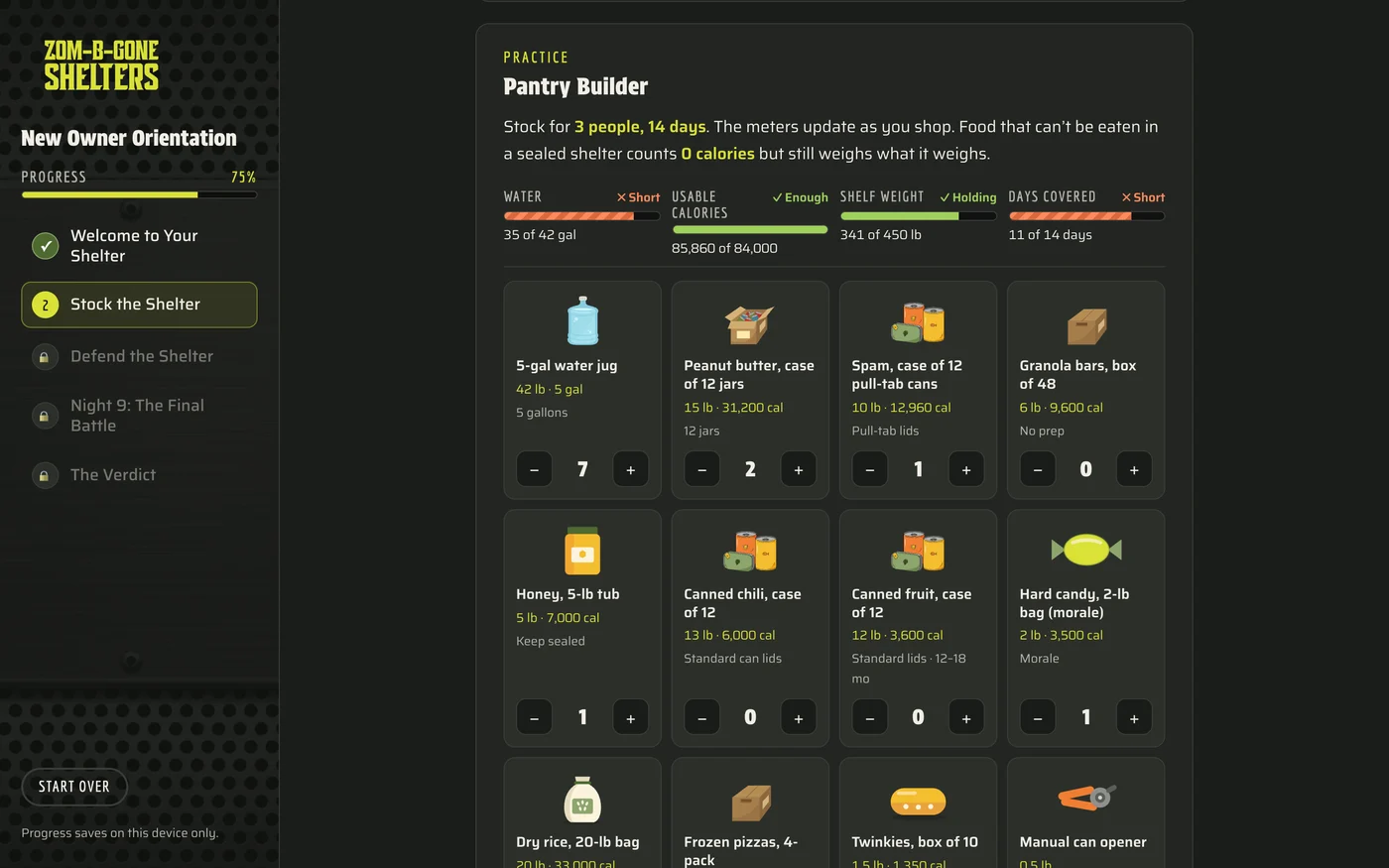
Every module opens on a problem from the owner's own shelter: an empty shelf, an open vent. Gus, the deadpan install tech who narrates, stocks a shelter for two with the math on screen. Then the learner stocks one for three with live meters and feedback. In the final battle the meters and hints are gone.
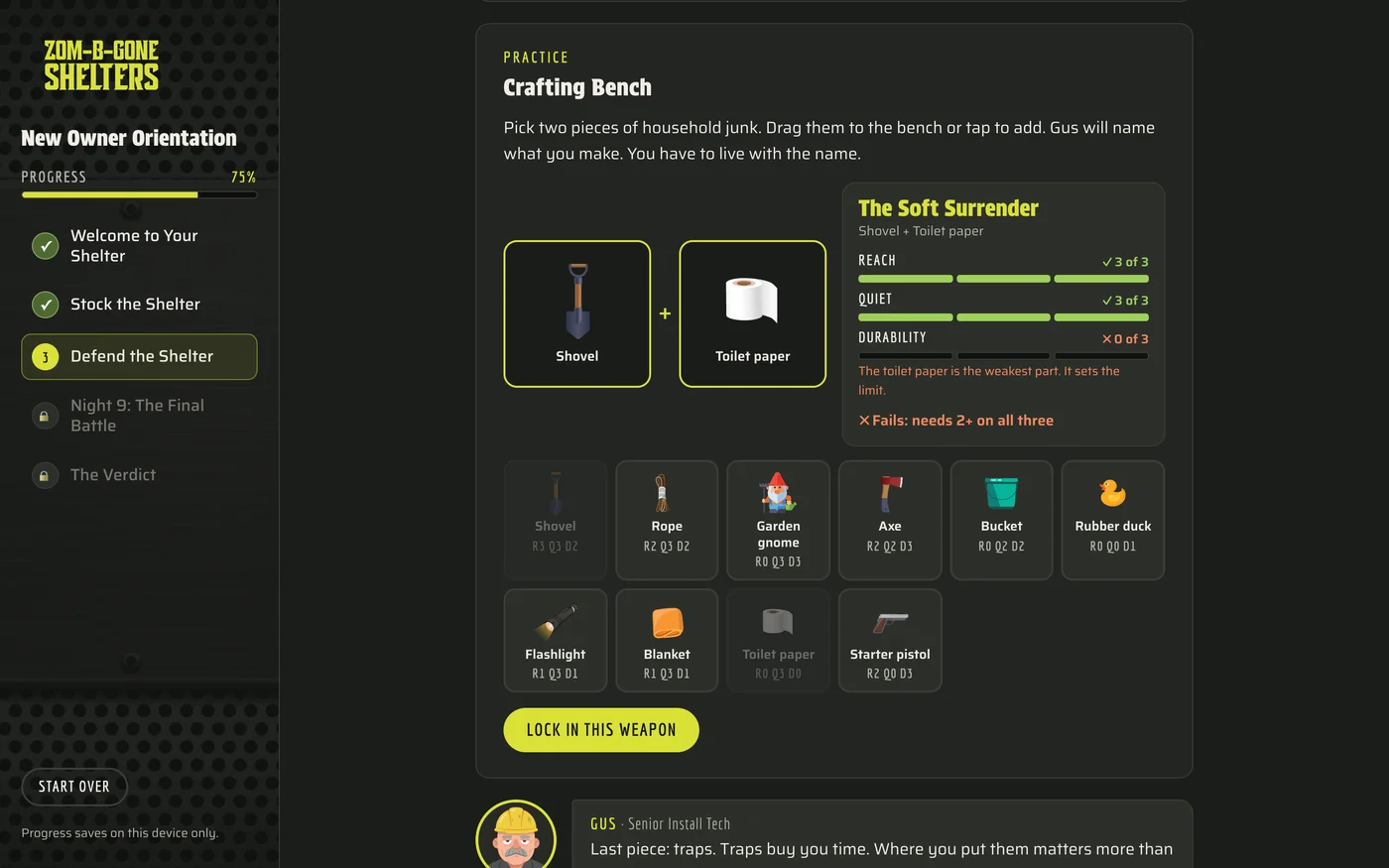
Practice is decisions with consequences, with no trivia quiz. The Pantry Builder counts food you can't eat in a sealed shelter as zero calories, but it still counts against the 450 lb shelf limit. On the Crafting Bench, a weapon is only as quiet as its loudest part and only as durable as its weakest. The scoring teaches the rule, and Gus names it.
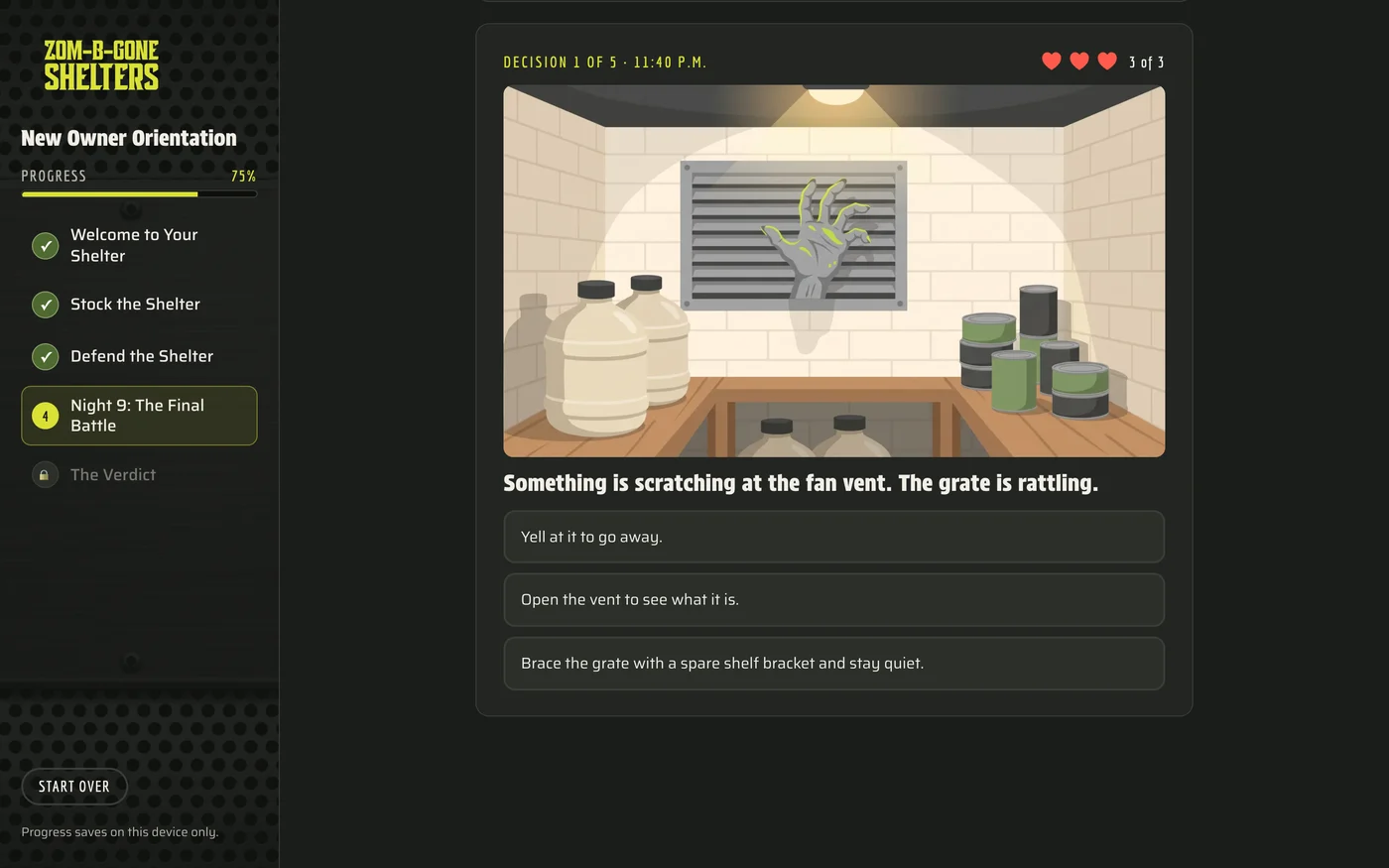
Night 9 is the summative assessment. It is five decisions with three hearts, and it pulls in the learner's earlier results. A pantry that failed costs a heart before the first decision. A weapon that failed removes the best option at the hatch. Lose all three hearts and the zombies win. The debrief names the rule that was broken and the section to revisit. A retry restarts only the battle.
The jokes always sit next to the rule and never replace it. The page structure follows Mindsmith's pattern: short pages, with one block at a time revealed by Continue. Every drag interaction also works by click and keyboard. Results show as icons and words, never color alone, and the course respects reduced-motion settings.
Built in HTML, CSS, and JavaScript with Claude Code. Scene art was generated in Higgsfield, using the supplied pack as the style reference.
 Enlarge
Deliverables
- Interactive course: 5 sections, 36 screens, 16 block types, and a printable certificate
- Learning design document: performance goal, objectives, a map of learning theory to design decisions, and the assessment design
- Storyboard with every line of copy and feedback
- Asset list with generation prompts
- 11 generated illustrations and 5 hand-drawn icons, all matched to the supplied pack
Evidence of quality
This is a challenge entry. It hasn't been run with real learners, so there is no impact data yet. What I can show:
- 20 automated tests cover the pantry math, weapon scoring, trap outcomes, and both battle endings. All 20 pass.
- A full keyboard-only pass.
- A full pass at 375 px phone width.
- Every food and water rule traces to Ready.gov, USDA, or CDC.
If this went to real owners, I would track battle retries per decision to find the rule that isn't landing.
What I learned
Humor buys attention for about one screen. After that the learner needs a decision to make. The scoring did more teaching than any text block. Shovel plus toilet paper fails on durability, and Gus names it The Soft Surrender. Nobody needs the weakest-part rule explained twice after that.
Link: Try the course